Halloween QAL · Quilts

Hallowe’en 1904 QAL–Step Four

Step 4 halloweenQAL

It’s the WONKY STARS step!

If you are appliquéing your stars onto your smaller background blocks, go for it and we’ll see you next month.  For the rest of you, even those not making this quilt, I’ll walk you through a stack and slash version of a star, pioneered by Thelma of Cupcakes and Daisies.

HalloweeenQuilt 1008dollars

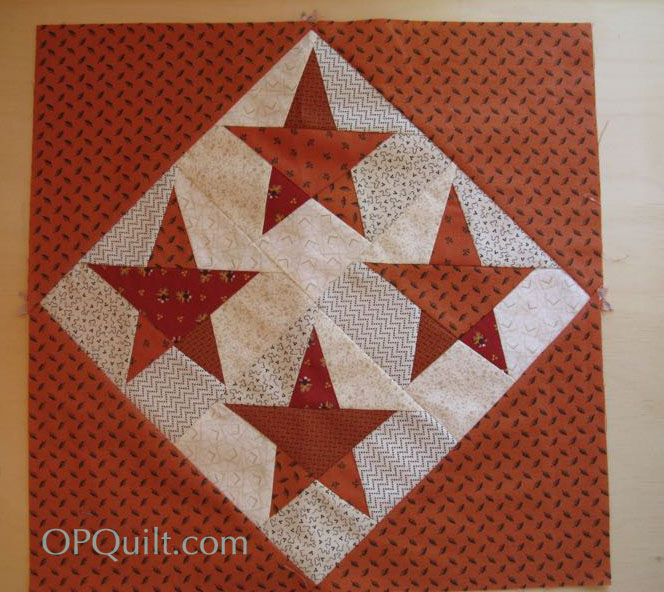
You’ve seen this before; this is an image I found on the web some time ago of the quilt we are making, Hallowe’en 1904 by Blackbird Designs.  Yes, we are again hard at it for the Hallowe’en 1904 Quilt-A-Long.  All of four of us will have quilts ready for Halloween, so I’m excited about that prospect. Well, maybe it’s more than four of you out there in the Internets, but at least two of us — Leisa and I — will be among those finished in time for that fall celebration.

Again, Leisa and I are making NINE blocks, down from the original twelve in the pattern.  I posted a version of smaller quilt *here,* using all twelve blocks and formulated by Mary Burton.  But we’re doing nine, with four appliqué and five star blocks.

A recap of last month’s sewing:
halloweenqal3_60
halloweenqal3_61
halloweenqal3_62
halloweenqal3_63

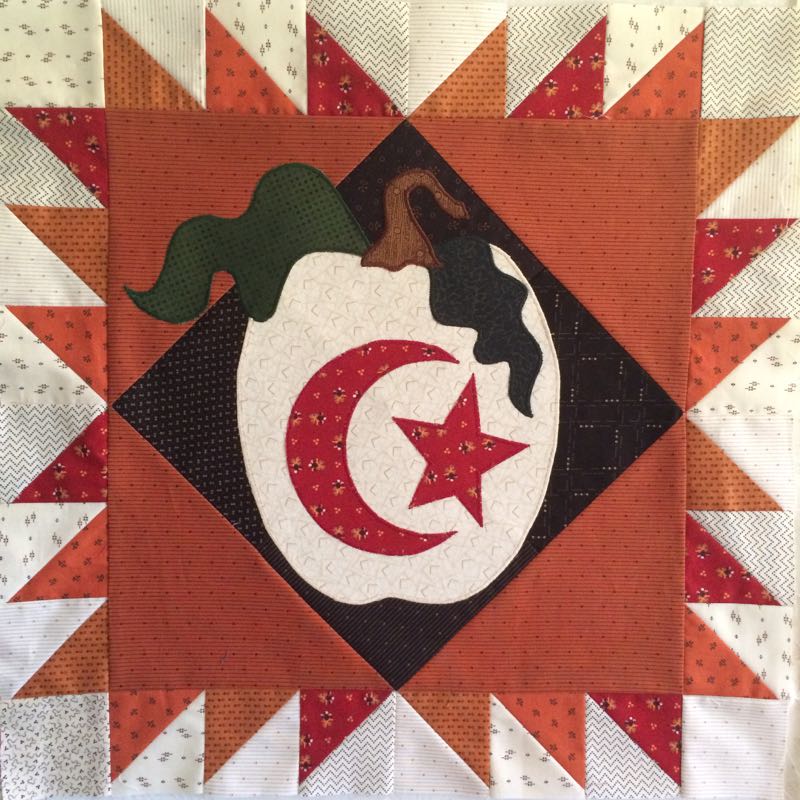
Yes, all four are done, even the one with the weird-o leaf.  It’s staying put for now.
touching up stitching

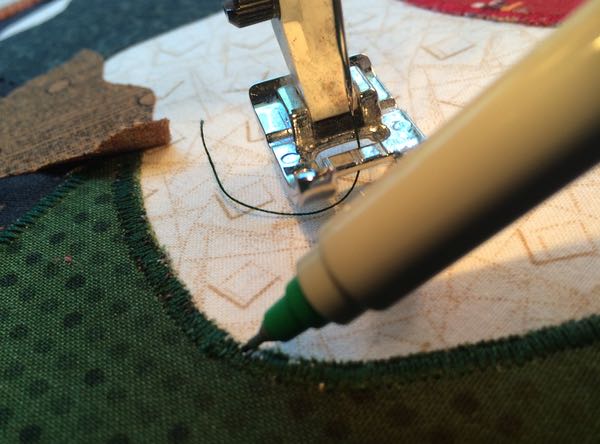
Here’s my tip for touching up those stray bobbin threads that work their way up if you are doing satin stitch: get out a Sharpie marker in the color of your thread and color it in.  I also use it for errant free-motion-quilting oopsies.

And this time, we’re heading right into How to Make A Wonky Star.  If you want to go the traditional route, of cutting and appliquéing your stars down to your background, go ahead and get going, and we’ll see you next time, on June 13th.  Anyone else who wants to learn this technique, stick around.

crazy nine patch block

(from here)

It’s not a new technique as we used to use it to make things like nine-patch blocks: stack up a bunch of fabrics, cut, swap out the fabrics and sew.  I also found a version of this stack-and-slash used in a star block, and the copyright on the page says it’s from 2000-2005. And Bethany Reynolds is credited with the first national use of the technique known as Stack-N-Whack.  I tell you all of this to say there is nothing new under the sun, especially in quilting, but only new turns at an old technique or form or idea.
Halloweenqal4_0

Halloweenqal4_1

We’ll get this far this month, but will do five of these blocks, saving the points around the outside for next month (although you are free to move forward if you want).

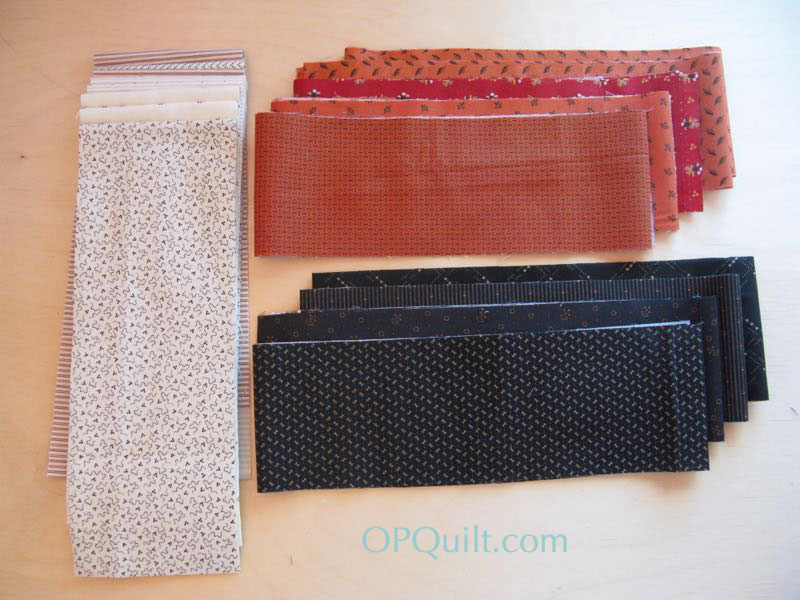
Get out your strips of fabrics, cut according to the chart.
halloweenqal2_wonkystar1
Halloweenqal4_5

Halloweenqal4_2
Halloweenqal4_2a

Different versions of the Stack & Slash Star pattern. I drafted and revised this star block multiple times, trying to get the proportions of the Stack & Slash pattern correct. For this reason, please print off only enough for your own use.  Please don’t print off enough for your mother or your girlfriend; send them here to get their own.  

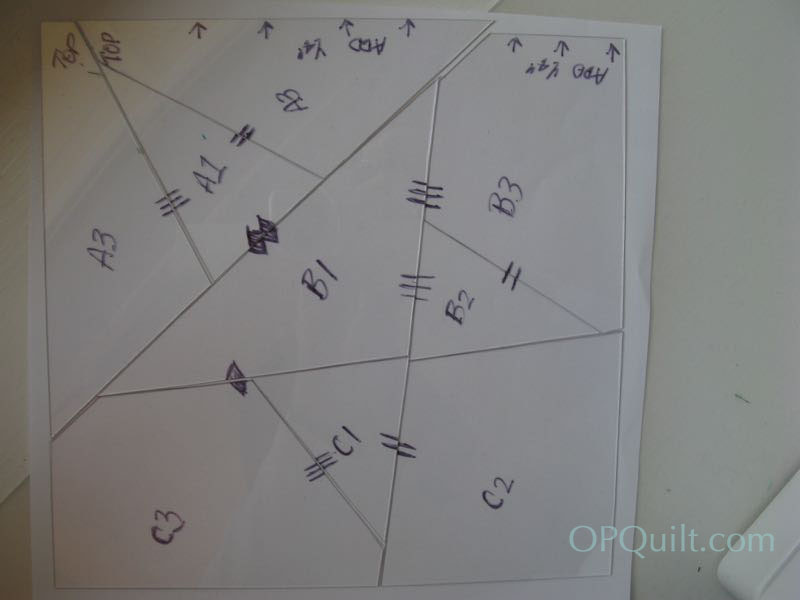
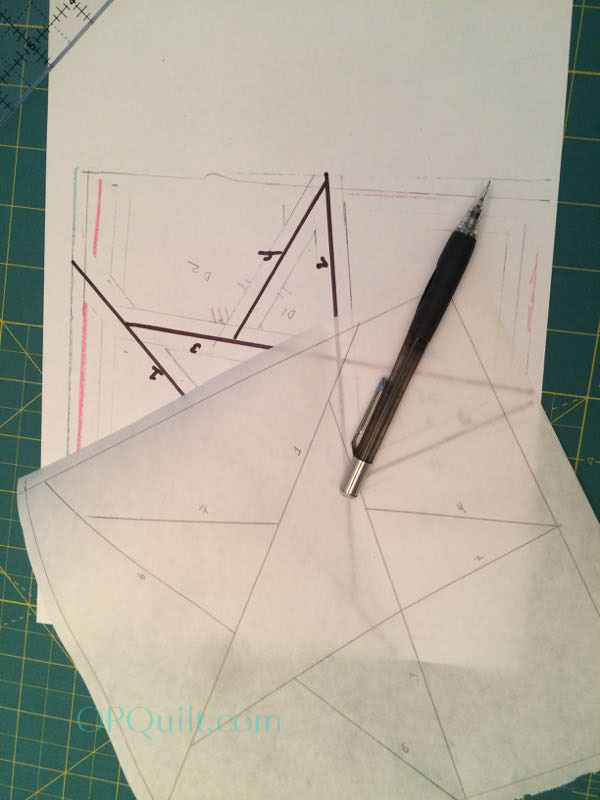
Print off two: one to use for a template for your star patterns, and one to use as a map for when you are piecing.
Halloweenqal4_6

You’ll notice on the pattern that there are lots of little diamonds and slashes.  (These are your notches to help you get the thing back together.  It doesn’t matter if you use mine, or make up some marking system of your own, but please do this!)  Lay some clear template plastic over the pattern and trace.  Looks like mine got reversed somehow, but really it just doesn’t matter one way or the other.  Now pay attention to what is the center of the star (A1, B1, B2 and C1) and what is the background (all the rest).

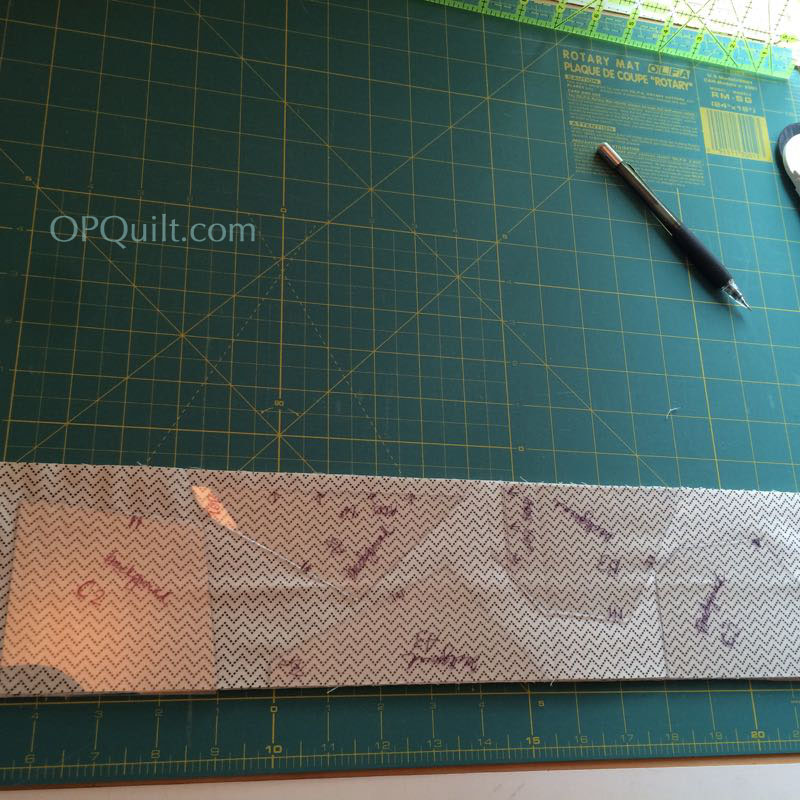
Working with a single layer of fabric (yes, you can stack them up, but don’t put the fabrics back-to-back unless you want to have some “regular” stars and some “reversed” stars.  It will drive you a bit crazy, but it’s do-able, in case you forgot), lay out the background templates. (See example below)

Halloweenqal4_10

If you do the usual cut of WOF, you’ll have part of the fabric facing you and part of it will be facing down to the cutting table, because of that fold.  Unfold it before cutting and you’ll avoid this problem.  I just had to go back in and cut some parts “backwards” and I made enough for a star or two.  So  you’ll notice that some of my stars are wonky to the left, and some are wonky to the right.  It just doesn’t matter.  Really.

Halloweenqal4_7

Halloweenqal4_8

Cut around them.

Start stacking up your pieces underneath the templates as you cut them

Halloweenqal4_9

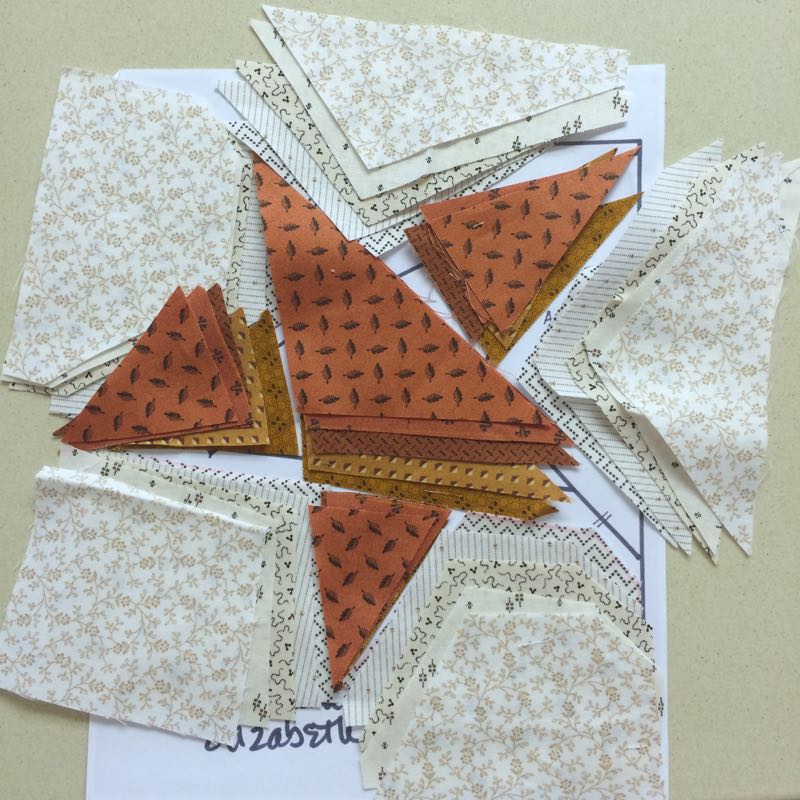
VERY IMPORTANT:  To get the appropriate amount of wonkiness, you’ll need at least FIVE different background fabrics, because there are 5 different pieces to the background.  If you want to have the star pieces all different, you’ll need FOUR different star fabrics, because there are 4 different pieces to the star. But so you don’t lose your marbles in construction, cut FIVE different background fabrics and FIVE different star fabrics.

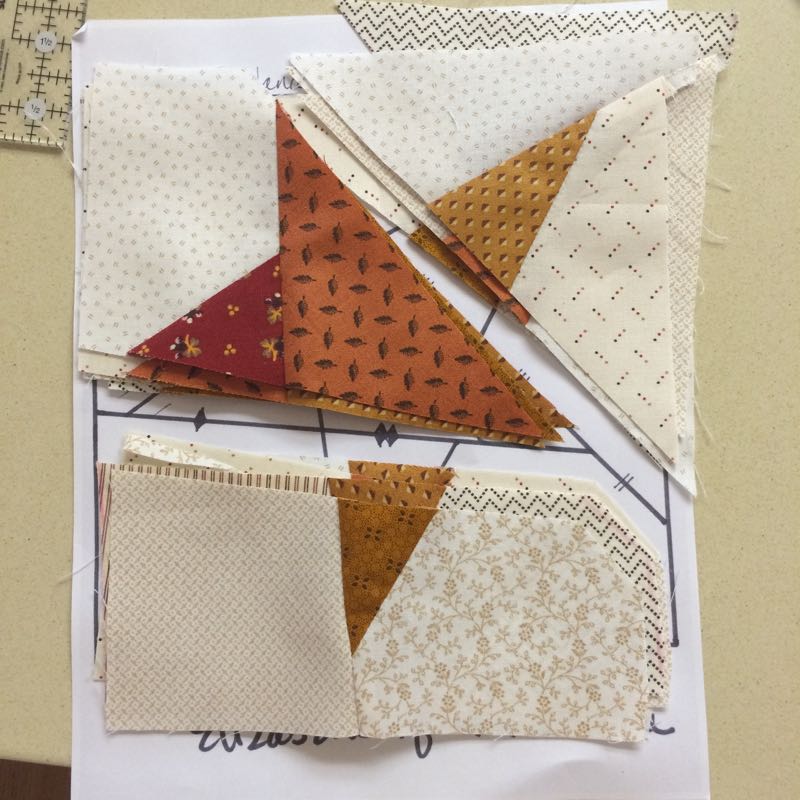
You’ll need to do some shuffling as you sew.

Halloween wonky star1a

Halloween wonky star1b

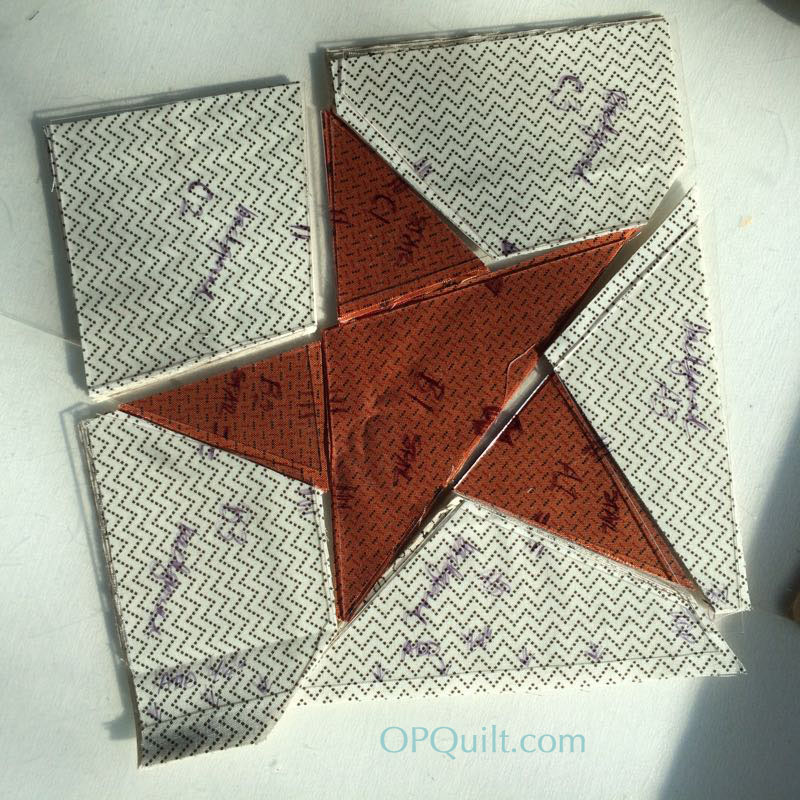
This is the “map” of the Stack-and-Slash Star (another printed copy) so I could use it as a way to keep all the pieces straight.  Here you see five different star fabrics.

I cut, then laid out the five different background fabrics, too.

StackSlashMap

First we’ll do the BACKGROUND fabrics.  Leave the star fabrics along.

1–Leave background stack A3 (upper left in this photo) alone.  Starting with stack A2 (upper right), take the top fabric and move it to the bottom of the stack. Now move around the star in a clockwise fashion (or refer to the photo to the left which has the pieces listed).

2–Take C2: Take the top TWO fabrics and move them to the bottom.

3–C3: Take the top THREE fabrics and move them to the bottom.

4–B3: Take the top FOUR fabrics and move them to the bottom.

Halloween wonky star1d-backgrounds

All the backgrounds have been switched, but the star’s pieces are still in the same order.  Now we’ll do the STAR fabrics:
Halloween wonky star1f-tip

1–Referring the map above, start with A1 (leave it untouched).
2–B1: Take the top fabric and move it to the bottom.
3–C1: Take the top TWO fabrics and move them to the bottom of that stack.  Now keep reading.

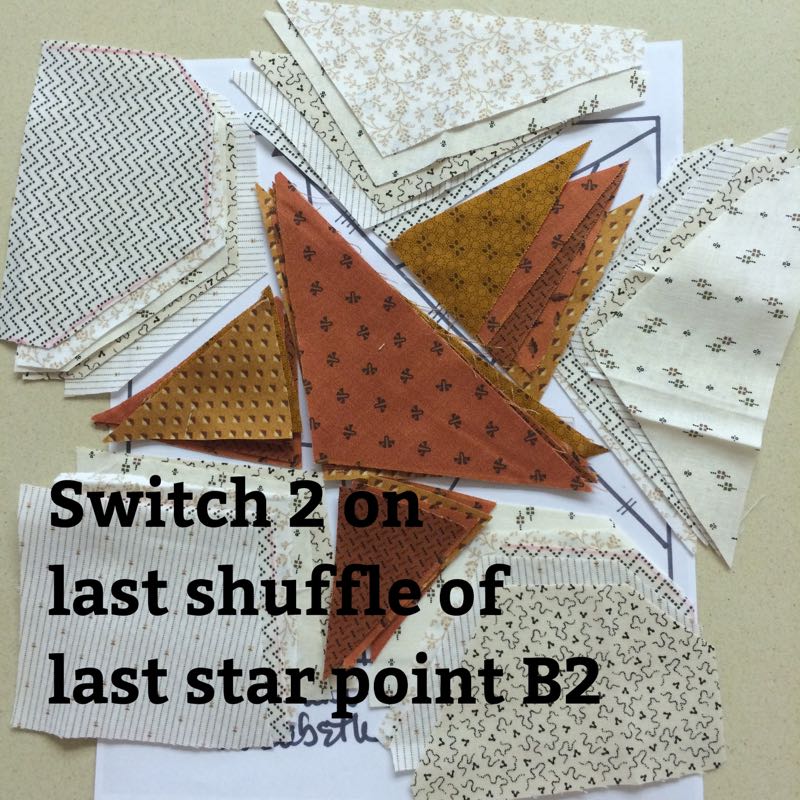
4–Since you have FOUR star pieces, you’ll need to do some switch the the top FOUR fabrics on the piece B2, and move them to the bottom of the stack.  I don’t know why, and no, this isn’t the Gospel Truth, and yes, I could have said it wrong, but that’s what I did to get them all different.  This way, when you sew that last star (star #5), you won’t have two the same on the last one.  If you do it differently, please let us know in the comments.

If this is all too confusing, on YouTube there are multiple videos — just type “stack and slash,” or “stack and whack.”  If you have a lot of time, *this* one is in four parts, but it’s very thorough.

Halloween wonky star2_assembly

Now we start sewing them together.  Sew the A parts together.
Sew B2 and B3 together, then sew them to B1
Sew the C parts together.

Above I show how I’m sewing them in parts, always replacing them back on my “map.”
Halloween wonky star2_trimming

Halloween wonky star2a_assembly

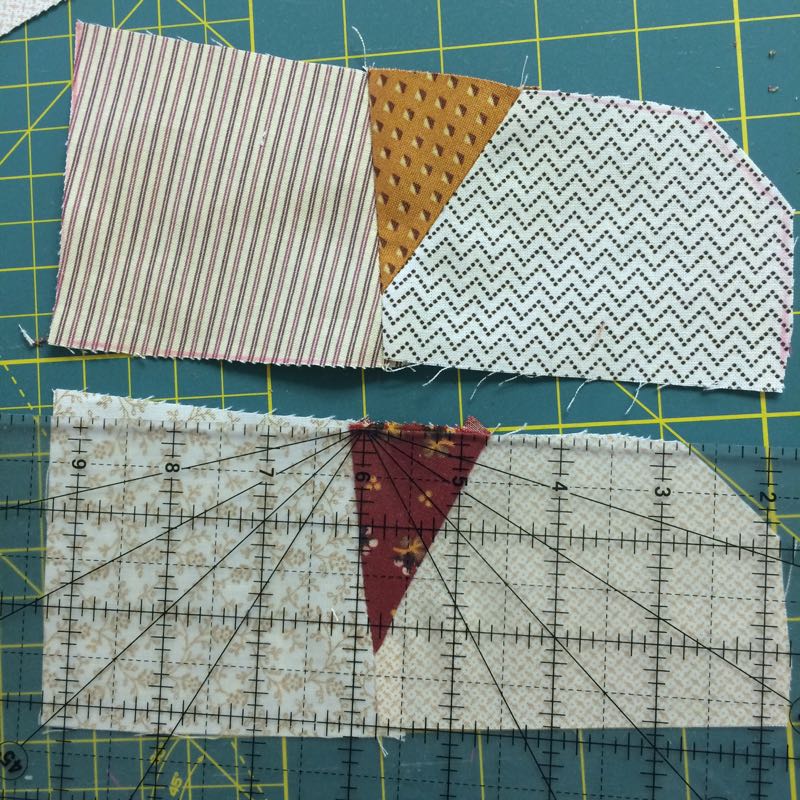
Some sections need straightening up before I sew the next seam.  If they are too out of whack, just even them out.

Halloween wonky star2b_assembly

Now all the B-pieces are sewn together.

Halloween wonky star6trim

Sew them to the C-pieces.

I evened out that edge.  Notice that monster dog ear at the top right.  Don’t even worry about it–just slice it off.
Halloweenqal4_12

Halloween wonky star7_true up

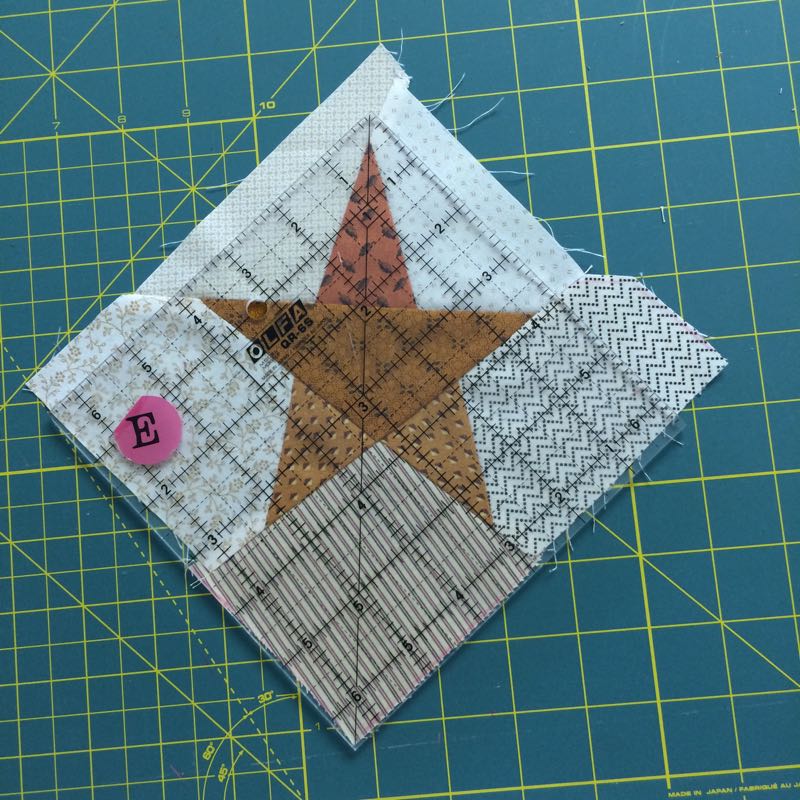
Join the sections together, pressing the seams to one side.  All the outside edges are skitty-wampus, but it’s all sewn!
Halloween wonky star7a_true up

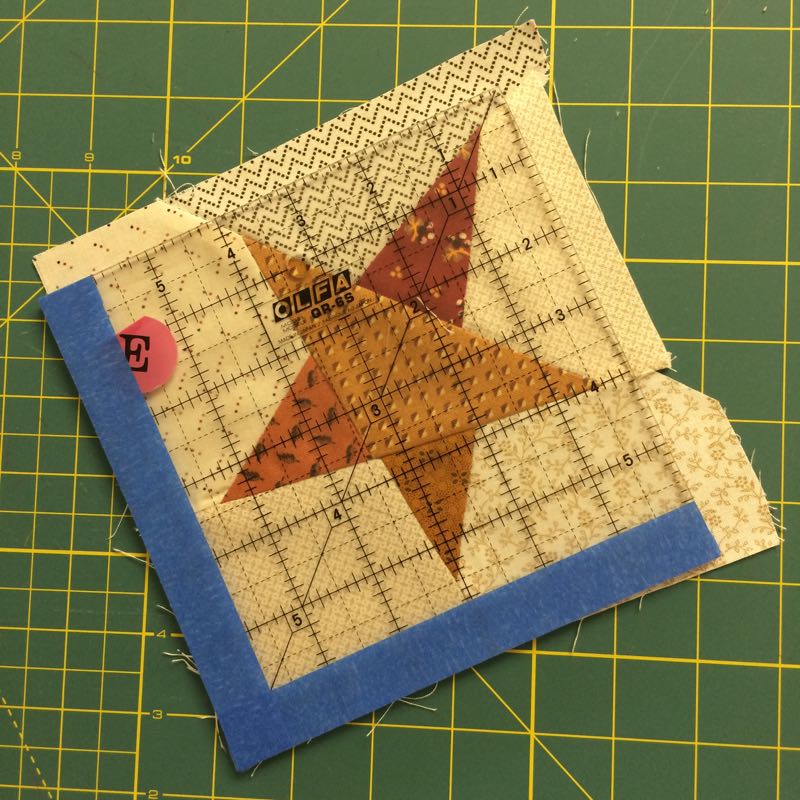
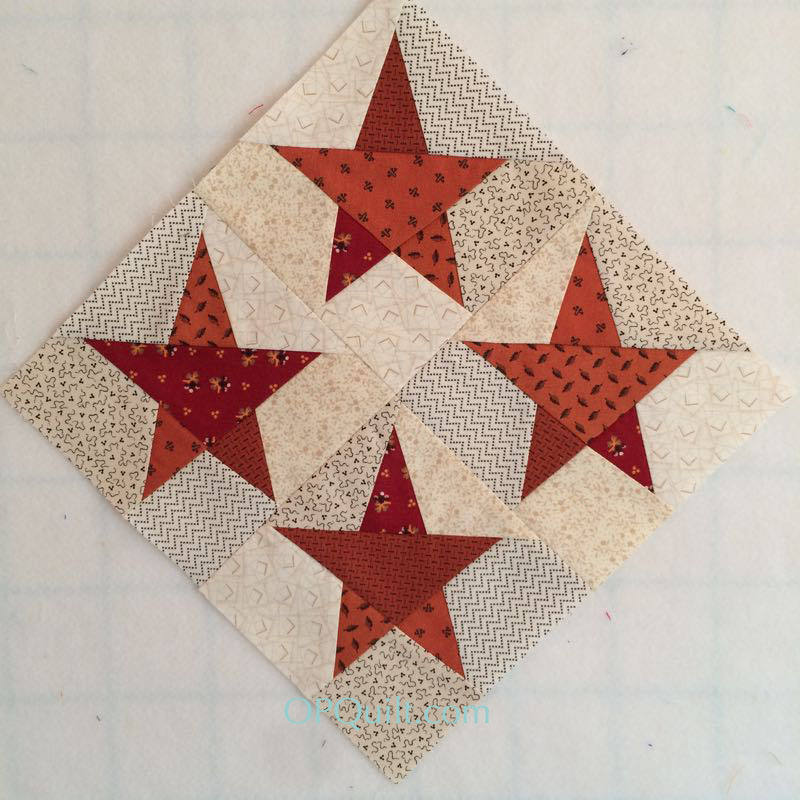
Now it’s time to even them up to our Gold Standard Measurement of 5 1/2″.  Find the A1 piece and put that in the upper angle corner and then monkey your ruler around until you have a nice mostly-even space around all the start points.

I put tape on the 5 1/2″ mark so I could frame it up better.  Now you see better how I laid it on the wonky star.  Repeat this over and over.  You can cut and sew a bunch and it goes much faster, but have chocolate at the ready.
Halloweenqal4_14

Halloweenqal4_0

Add on your outside large triangles, varying them from orange to black, as are your star points.  We’ll save the outside HSTs for next month.  So, get busy making wonky stars and we’ll see you on June 13th!
1halloweenQAL logo

Here’s our schedule:

Step 1 (Preparation): February 13,  2016–buy all the fabrics and find the pattern.  Buy your pattern from The Primitive Gatherings Online.  Link is *here.* The quilt measures 90 by 90, which is too large for me, so I’m only doing nine blocks.  Each block is 20″ square, and with the outer borders, that should come to roughly  65″ square.  I may change my mind, but this looks good from here.

Step 2: March 13,  2016–Cut out the quilt: the tan backgrounds of the squares, the border triangles, the smaller half-square triangles, strips for the wonky stars, but save the piano key border for later.

Step 3: April 13, 2016–Assemble four blocks and add large appliques; use Thelma’s method (of Cupcakes and Daisies) for adding the curlicue stem. Make and add half-square triangeles (HSTs) around these blocks, using the 8-at-a-time method of HSTs.

Step 4: May 13,  2016–Cut and make the wonky star blocks from templates and strips.  I’m doing five blocks, so will need to make twenty wonky stars and true them up.  Add on the large outside triangles.

Step 5: June 13, 2016–Assemble the rest of the star blocks, by adding their HST borders. In the pattern, they are mixed up and varied, but also harmonized (some have a mix of orange and black, some have just black, some have just orange.)  Make your own rules and go with it.

Step6: July 13, 2016–Arrange the blocks on your design wall and stitch together.  Cut the pieces for your borders.  Make the four corner pinwheels.

Step 7: August 13, 2016–Sew borders together and attach them to the quilt.

200 Quilts · Quilt Patterns · Quilts

Spectrum: A Colorwheel Quilt

Spectrum_labeled

Spectrum: A Colorwheel Quilt
Quilt No. 153

Spectrum_Quilting1

You’ve seen this beauty before, as I’ve been working on it steadily since last summer.  Since this summer is about to arrive, I thought I should finish it up and get it up in my shops at Craftsy and PayHip (for EU quilters), in case anyone wants a colorful wheel of color on their sewing studio wall. Spectrum_detail

It’s also great for quilt swaps, or special gifts.  I started on mine for a swap, but soon realized I wasn’t going to finish it in time, so made for her instead another colorful creation of mine, Colorwheel Blossom.  (It was a colorful Kaffe Fasset fabric swap.)  But then I had two quilts, so I gifted one to someone who loves and uses Kaffe Fasset fabrics, keeping one for myself. Stack of colorful quilts

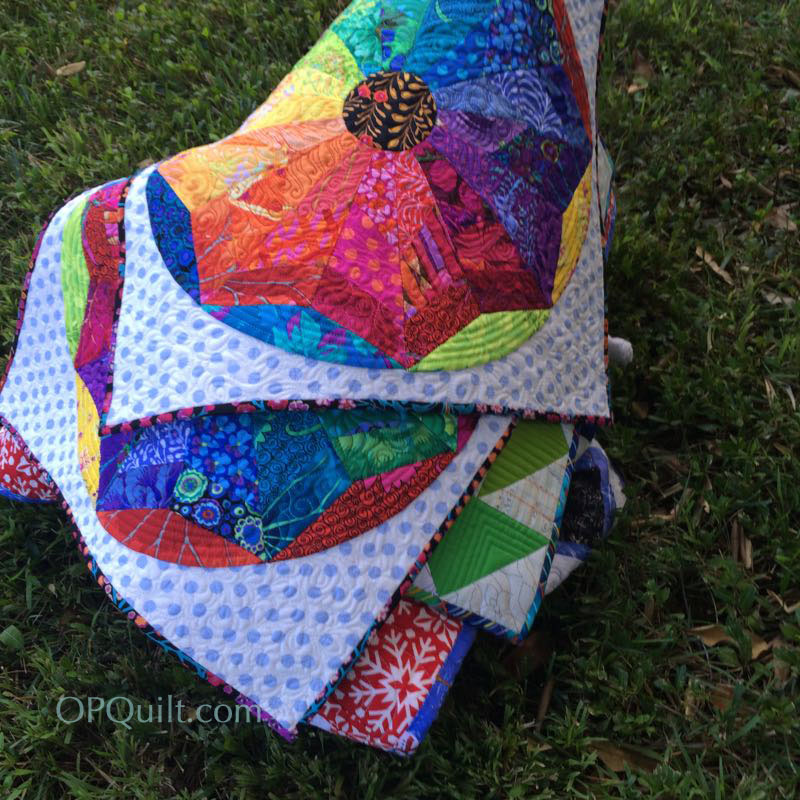
Before I sent my swap quilts off, I took them outside for some photos, and love this stack of fun (colorful?) quilts, a prism of quilty delights.

The pattern has templates for English Paper Piecing, if you like to do that sort of thing (I do!) and full instructions for how to put your quilt together.  While the color wheel is 16″ in diameter, the quilt can measure up to 18,” depending on the size of your background.  It is stunning made up in Kaffe Fassett fabrics, and I’m teaching it that way this Spring in classes at my local quilt shop.  Enjoy!

200 Quilts · Quilt Patterns

Riverside Sawtooth, a finished quilt top

Riverside Sawtooth_labeled

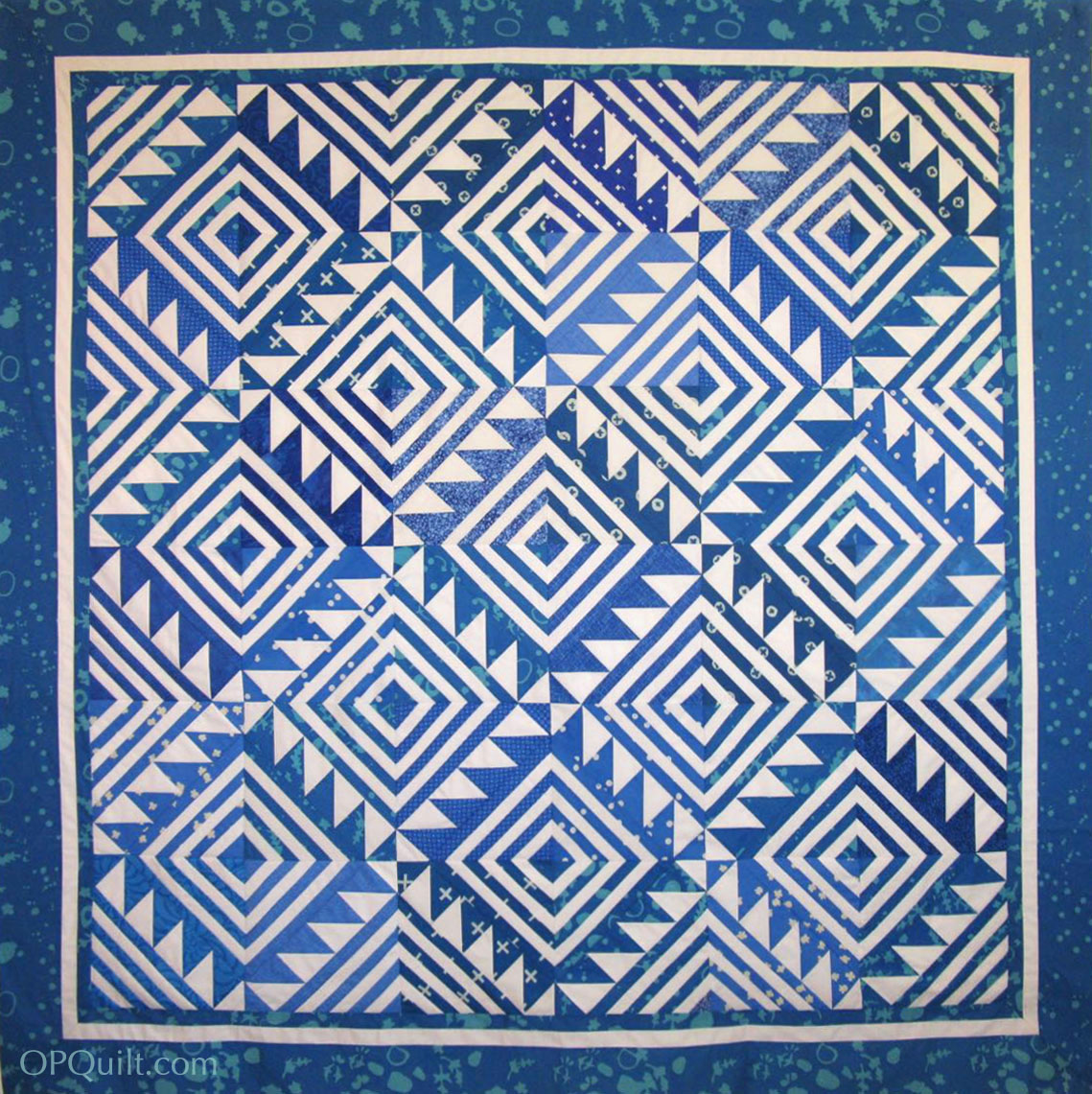
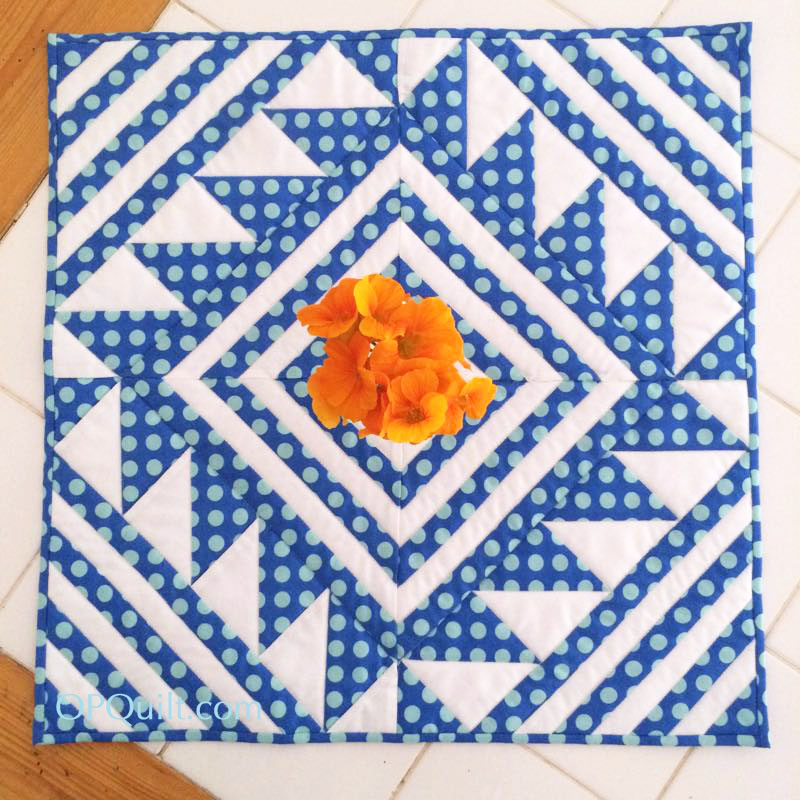
Riverside Sawtooth, the name I’ve given for this original block of mine, has been finished — or at least the top has. It is a compilation of bee blocks from the Mid-Century Bee, as well as several of mine.  I started making these in the Alison Glass blues fabric, but trying to describe what color of blue that was to people all over the United States was a challenge: I finally settled on “painter’s tape blue.”  I like this quilt not because of that color and that block, but also because it’s a scrappy two-color block.  Have a bunch of greens, or pinks, or reds that need to be gathered together into a quilt?  This would work great.
Riverside Sawtooth_small1

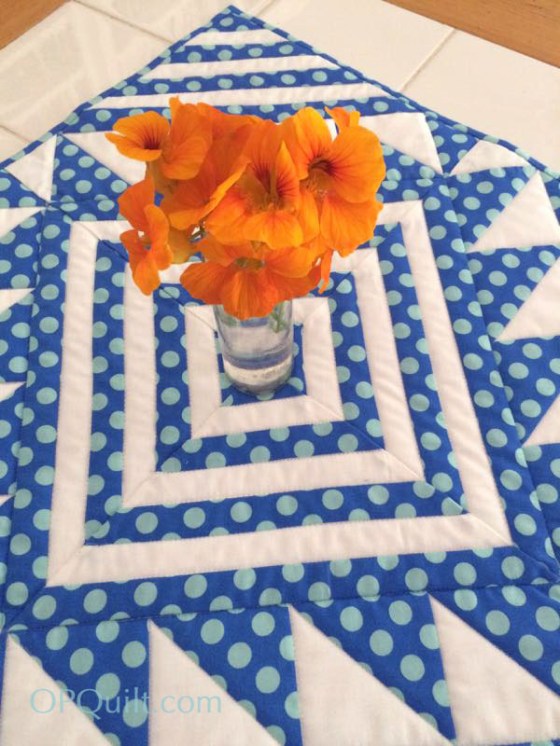
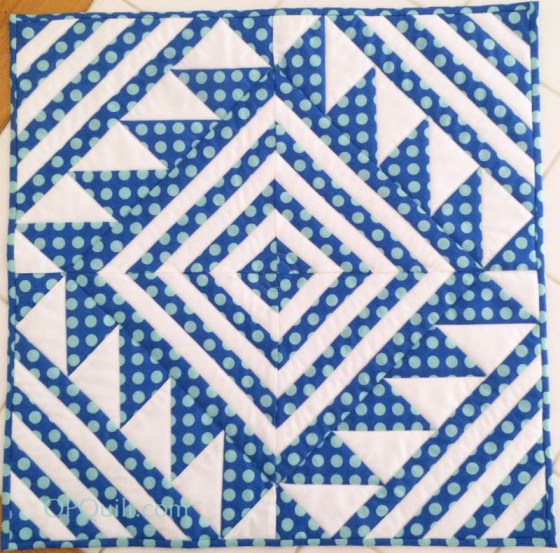
Through the process of arranging and cullling and making more blocks to balance colors, I had enough blocks for another small mini.
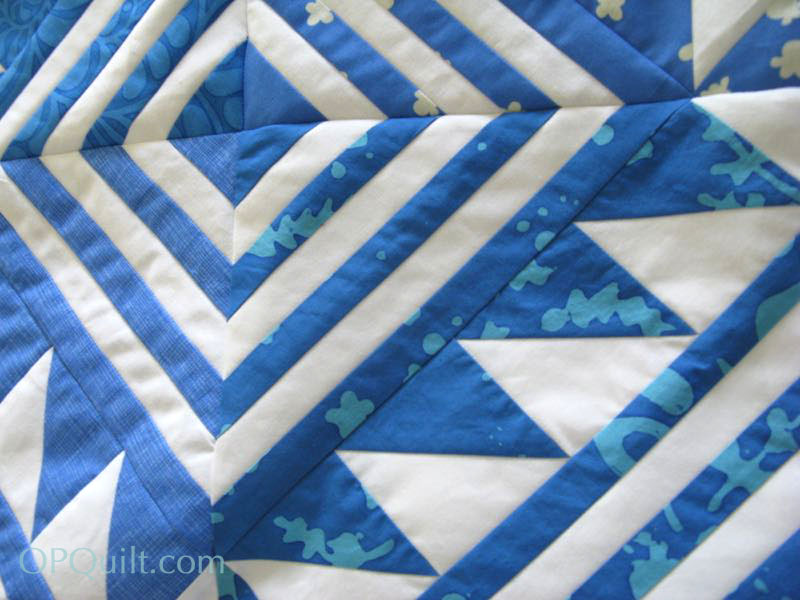
The genesis came from seeing a similar antique quilt, but that maker had done a more traditional construction (and sorry–there was no name on that old quilt).  I wanted to see if I could make it as a block, the sawtooth incorporated into the construction process.  It took me several weeks of working on it, then testing it.  I wrote up the pattern and sent it as a test block out to my beemates and incorporated their tips and tricks into the pattern wording.  Now thoroughly tested, I tweaked the pattern and at long last, have it available for download in my shops at Craftsy and PayHip (for EU customers).  The pattern includes lots of detailed photos and walks you through it the process, so it’s good for anyone’s set of skills, beyond the what-is-a-rotary-cutter-and-how-do-I-use-it barely beginning level.
Riverside Sawtooth_small2

Here’s another mini full of full dotty blocks.  I loved working in this tonality of blue — hey, I love blue in any tonality — but the inspiration of Alison Glass’ fabrics kicked me into finding blue fabrics that coordinated with hers.  The large quilt (72″ square) is in the line-up to be quilted, and then I’ll probably label it and get it up on the 200 Quilts list, but for now, I wanted to make it available to you, if you want to try your hand at an updated fun version of a block.

Riverside Sawtooth_detail1 Riverside Sawtooth_detail2 Riverside Sawtooth_detail3a Riverside Sawtooth_small3I’ve been working on a few more patterns and I’ll roll them out one by one over the next several weeks, as I get the typos expunged, the photographs completed and then uploaded for purchase.Riverside Sawtooth_small4

tiny nine patches

Oh Christmas Tree QAL · Quilts

Oh Christmas Tree QAL –STEP 4

5XmasTreeMay4

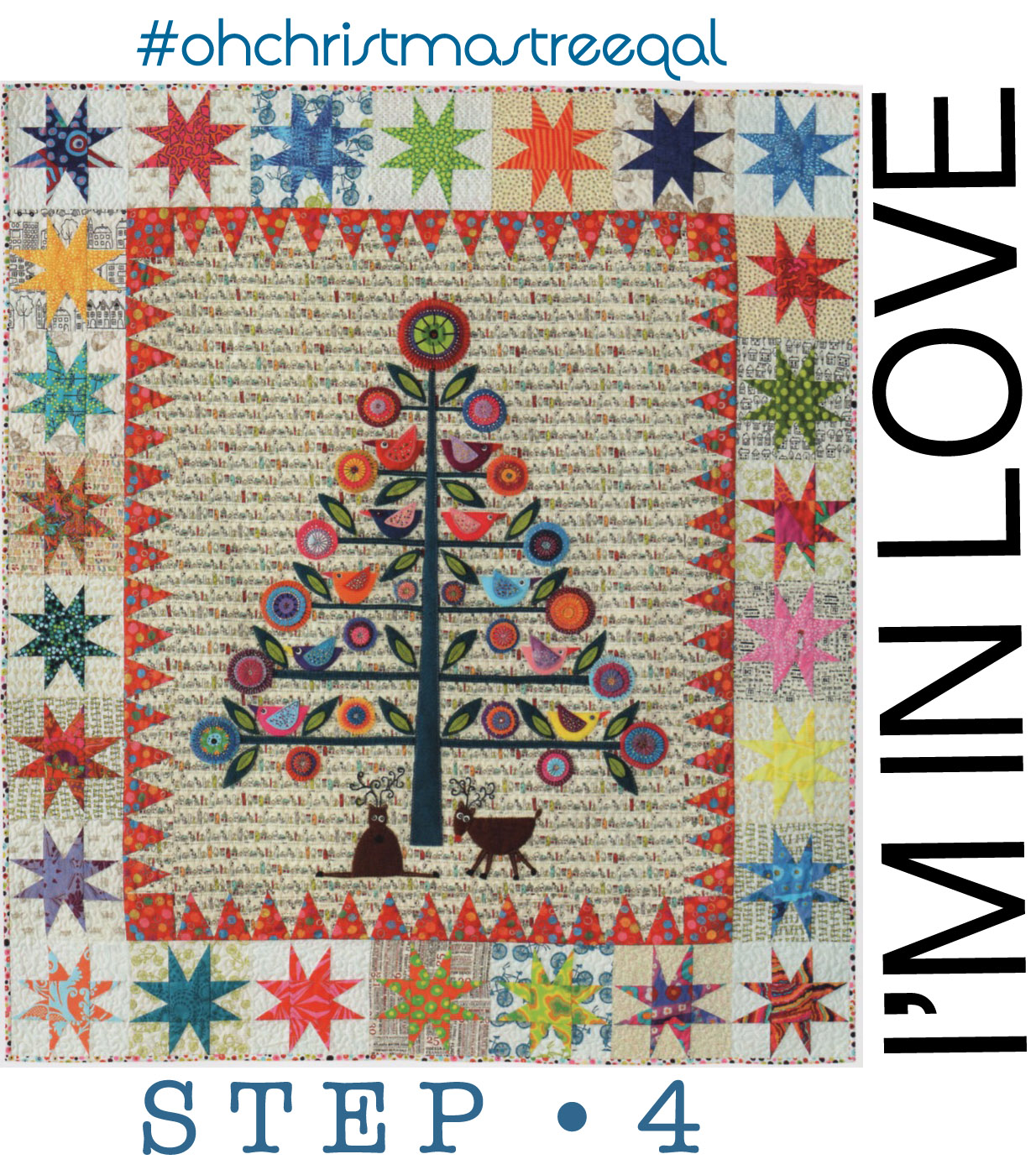
Today is Step 4 of our Oh Christmas Tree Quilt-a-Long (#ohchristmastreeqal), following a pattern by Wendy of FlyingFishKits and which was published in Simply Moderne issue #3, by QuiltMania. As always, we have an assist from Wendy of  Wendy’s Quilts and More (blog) and wendyquiltsandmore (IG), as she is slightly ahead of us in her creating.

ohchristmastree4_0treejpg

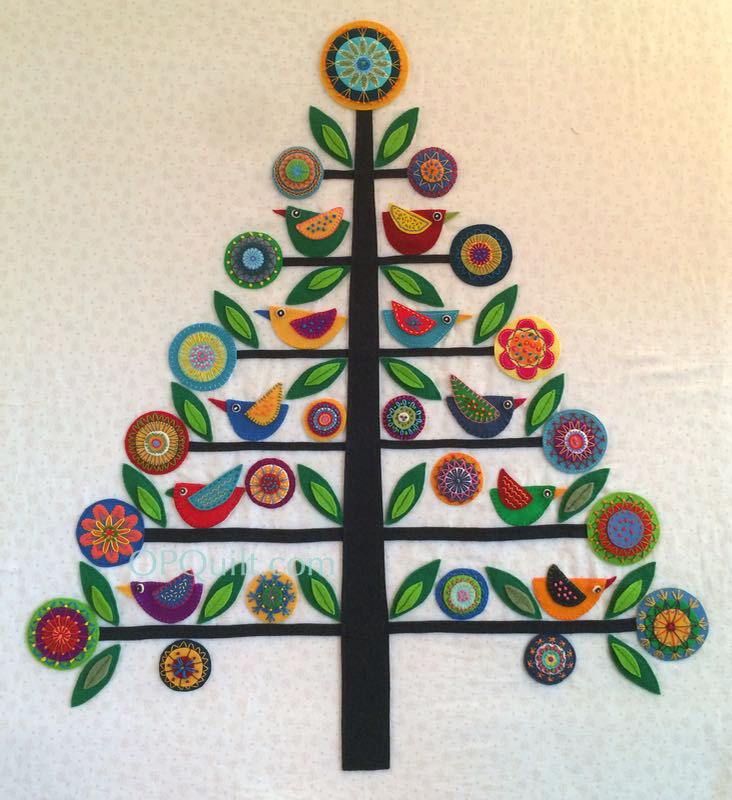
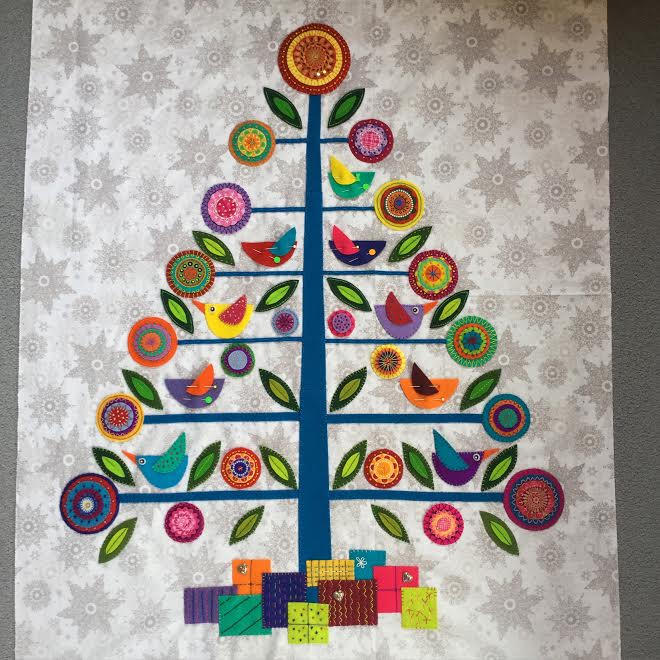
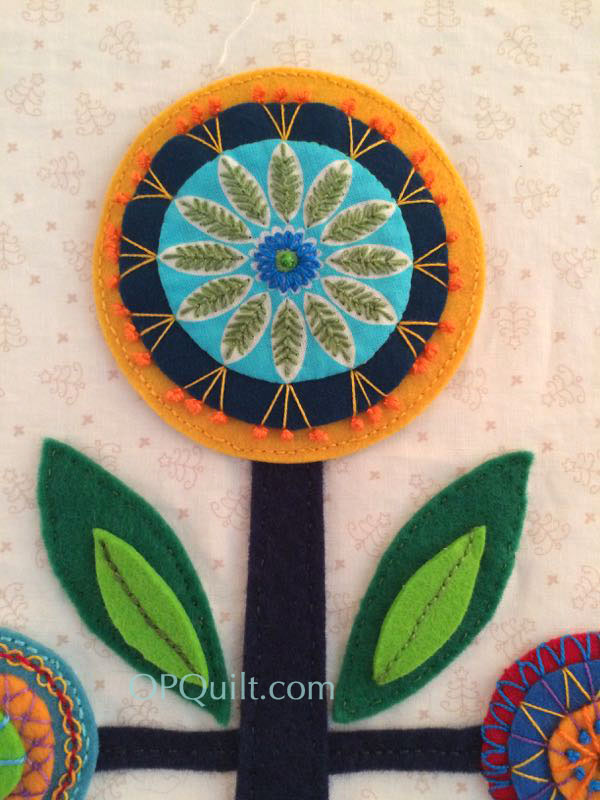
Here’s the twist: instead of creating the under-the-tree scene this month, I’ve gotten so many queries about sewing these things on to the background and the tree, that I think we’ll head that direction instead.  Go with the flow, right?  Above is my tree, everything sewn on.  I’m heading this direction because a lot of those questions have to deal with the idea of how much embroidery to put on that outer edge?  Should you leave a space for attaching and more embroidery?  Should you go right to the edge?

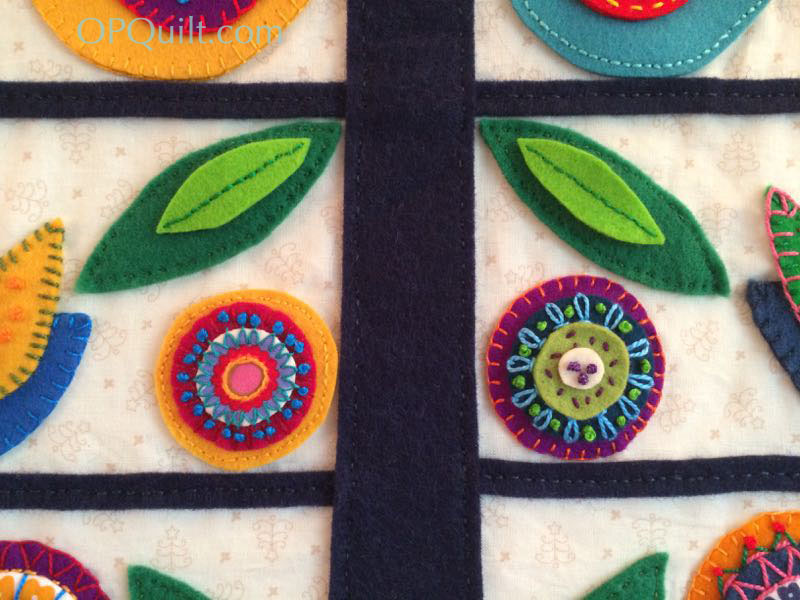
The basic idea for attaching is this: lay out your circles, birds, and leaves to your liking, using the pattern and photos as a guide.   As I go through the rest of the flower photos, I’ll have some tips, so please read through to the end.  But first! Wendy has some tips for us about what’s ON the tree:

ohchristmastree4_20

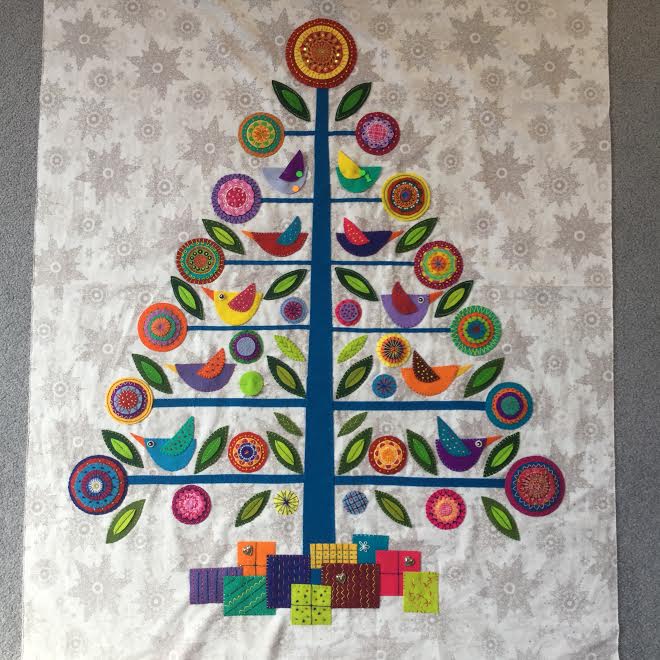
She writes: “I thought I had too much white space in certain areas.  I’ve added 4 more small leaves and 4 more small circles, keeping the additions symmetrical because the gaps were symmetrical.  I just felt some areas were less densely filled than others and I didn’t want gaps in the middle of my tree.  That’s probably because I didn’t exactly follow the pattern for the size of my leaves and flowers, but also because things move slightly as you sew them on.”  She sent me two photos.  The “before” is above.

ohchristmastree4_21

This is the after.  You can see extra circles and extra leaves.  (And yes, I love her under-the-tree scene!  Next month, next month.).  In addition to adding these extras, she attaches them differently than I do.  First she lays them all out, takes a photo so she can remember where they are, and then takes all off but the items closest to the tree trunk.  She sews those down first then adds in the decorations bit by bit, moving from the center to the outside, because she said she got tired of being stuck by pins.

ohchristmastree4_10

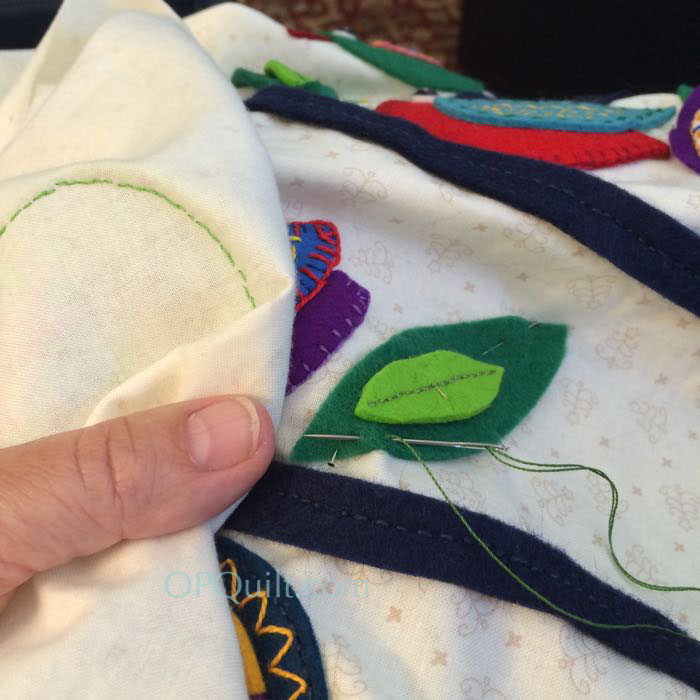
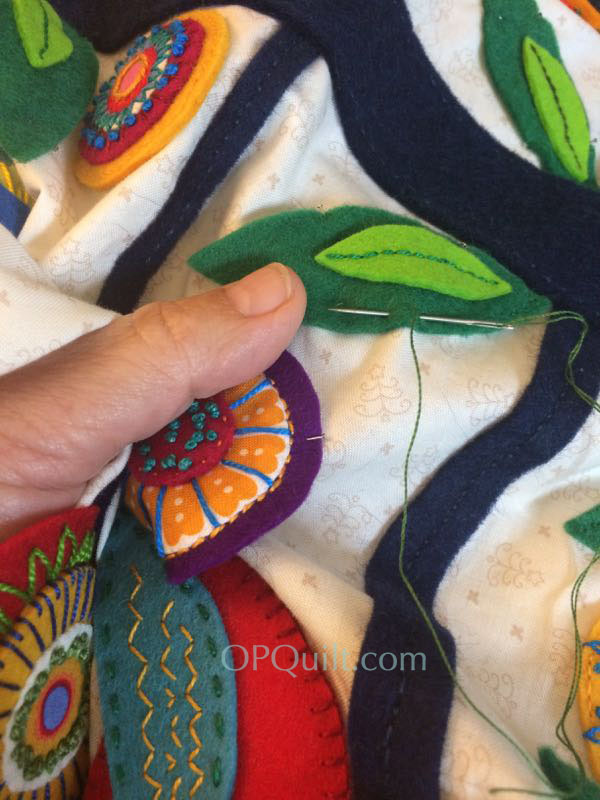
I couldn’t face the thought of re-attaching the flowers after I’d gotten them arranged, so I used appliqué pins (shorter than usual) and sewed on the decorations moving from the outside toward the center. Since I use really small pins, and put my hand around the flowers and birds as I sew, I didn’t have too much trouble.  One IG reader said she used a bit of glue to secure the decorations and from her photo it looks like she’s attaching them from the inside to the outside. Again, try what works for you.ohchristmastree4_11

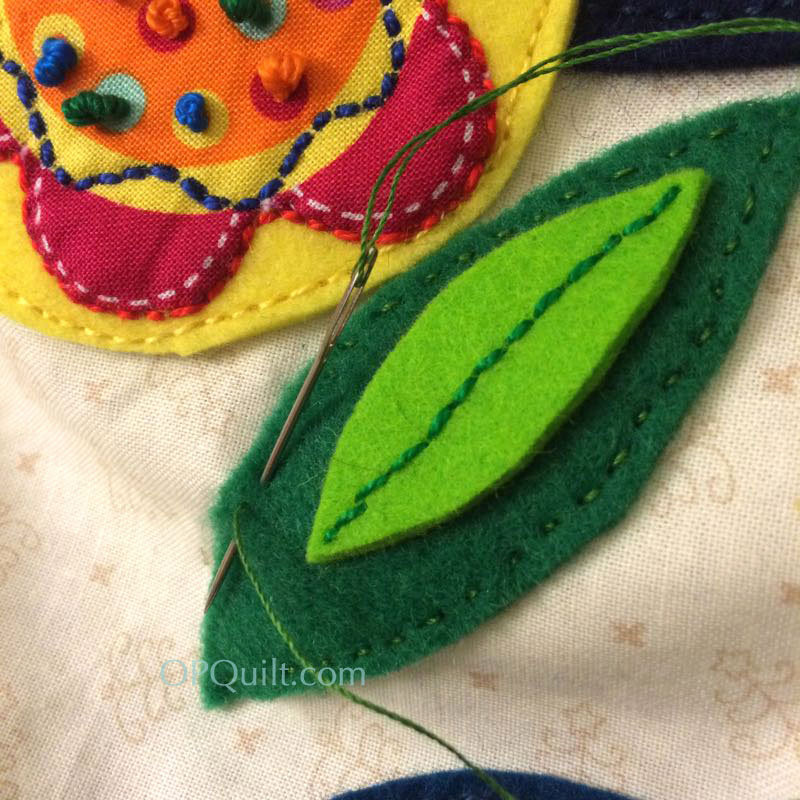
You can see me scrunching things up in my hand.  Since I worked from the outside in, I had very few pin pokes.  I attached the leaves by using the same stitch I used on the trunk: a separated back-stitch (refer to this post for more info).

ohchristmastree4_14I was intent on getting them all on, and doing it quickly.  You could take more time than I, adding an extra embroidery stitch, if you wanted, for it’s YOUR tree.ohchristmastree4_12

I also learned to put a regular pin right in the middle of my decorations just before I started sewing them on, so they wouldn’t buckle.  I have one bird who looks like she is expecting, as the wool can shift as you are attaching, bubbling up.  I’ll show the Mama Bird to you later.

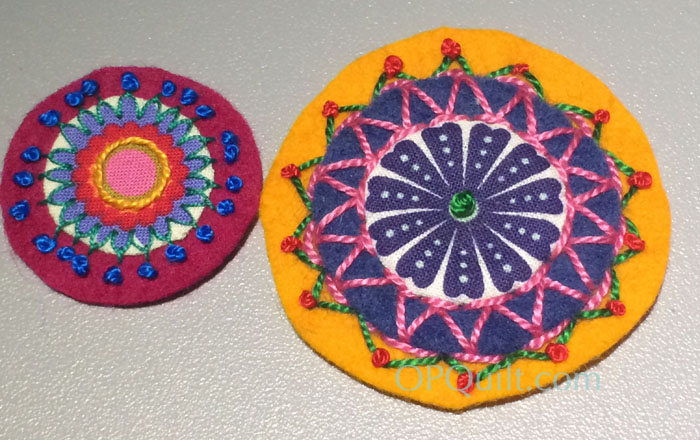
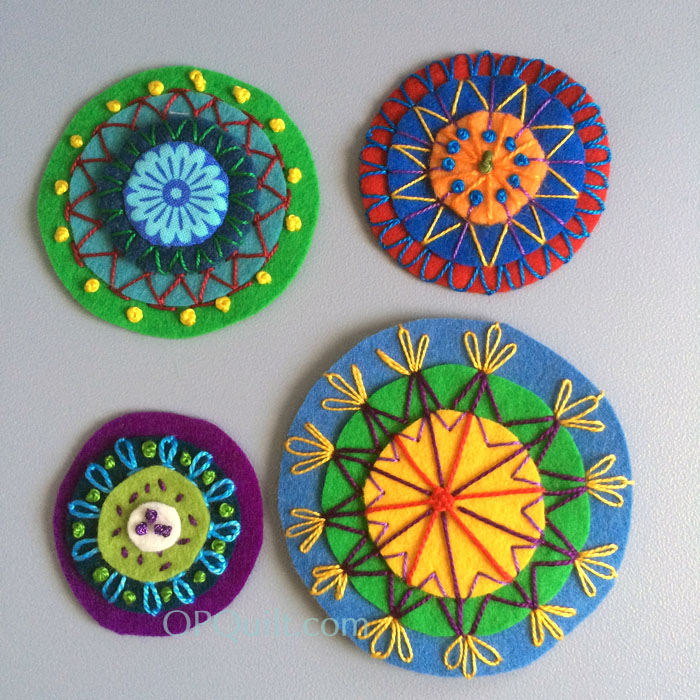
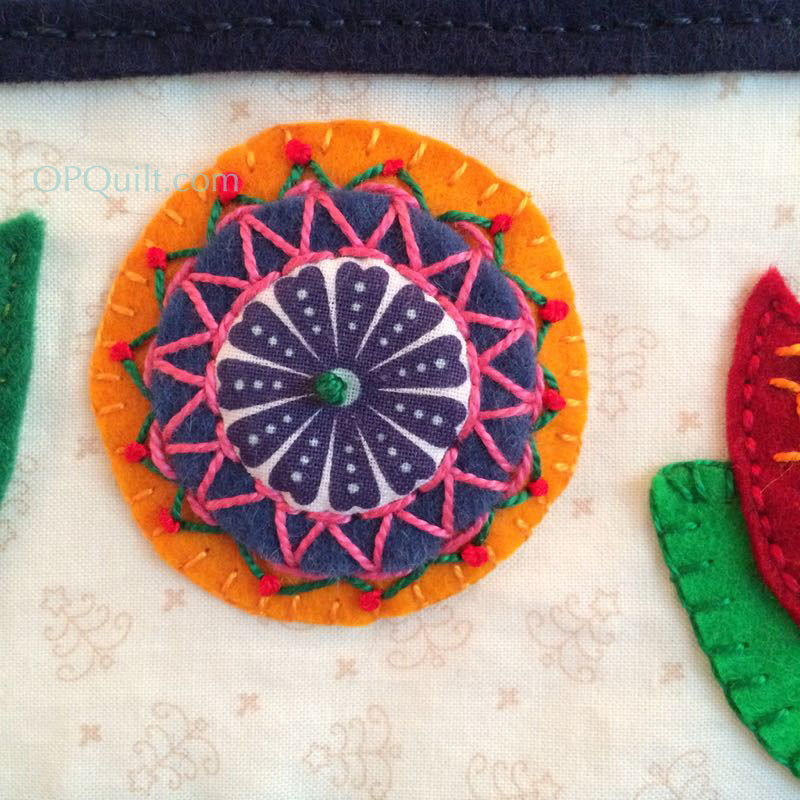
Now for some general tips about attaching the flowers and birds.  Before we talk about different ways to sew them to your tree, here’s a couple of photos of circles before attaching, showing various state of “close-to-the-edgeness” of the embroidery.ohchristmastree4_1flowers

After I pinned these to the tree, I went in and added another circle under the red one, giving it a bit bigger presence.  Ditto on the purple circle below.  You may find yourself making small alternations after you get everything pinned down, either adding leaves and circles as Wendy did, or giving another border to a too-small/wrong-color flower, like I did.ohchristmastree4_1flowers2

ohchristmastree4_5

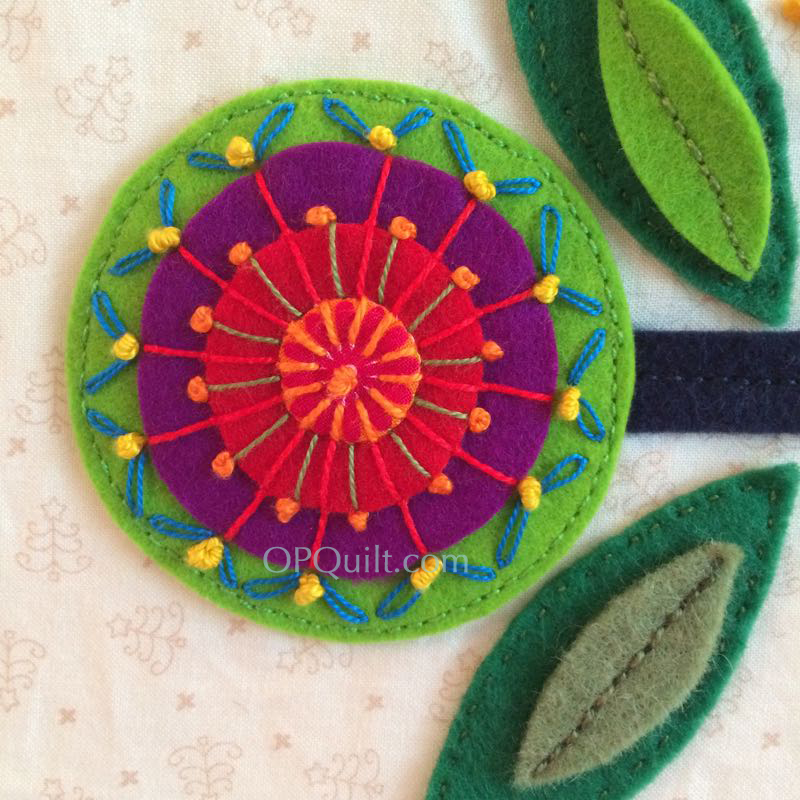
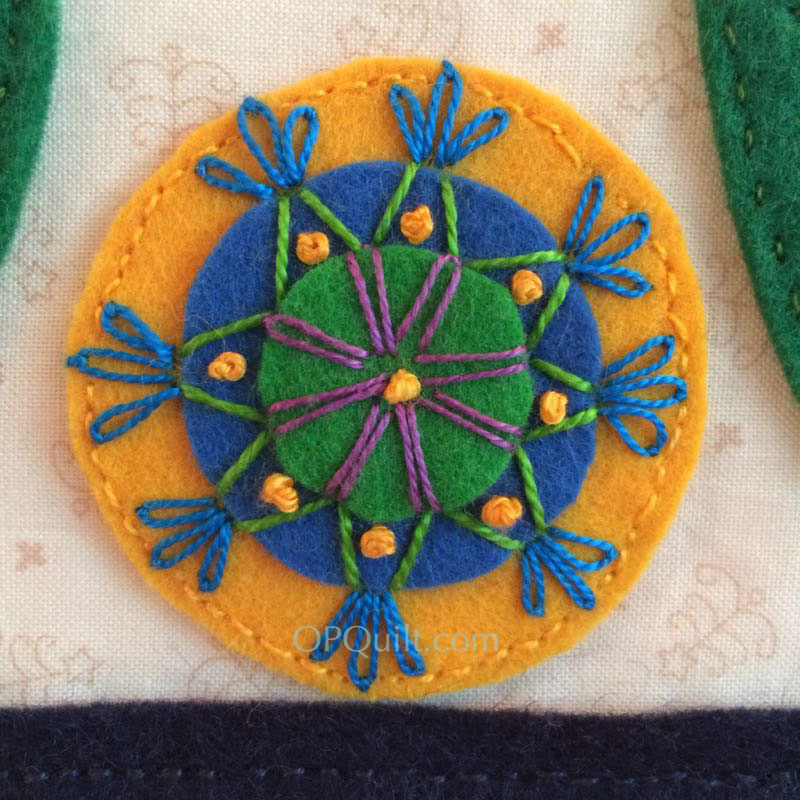
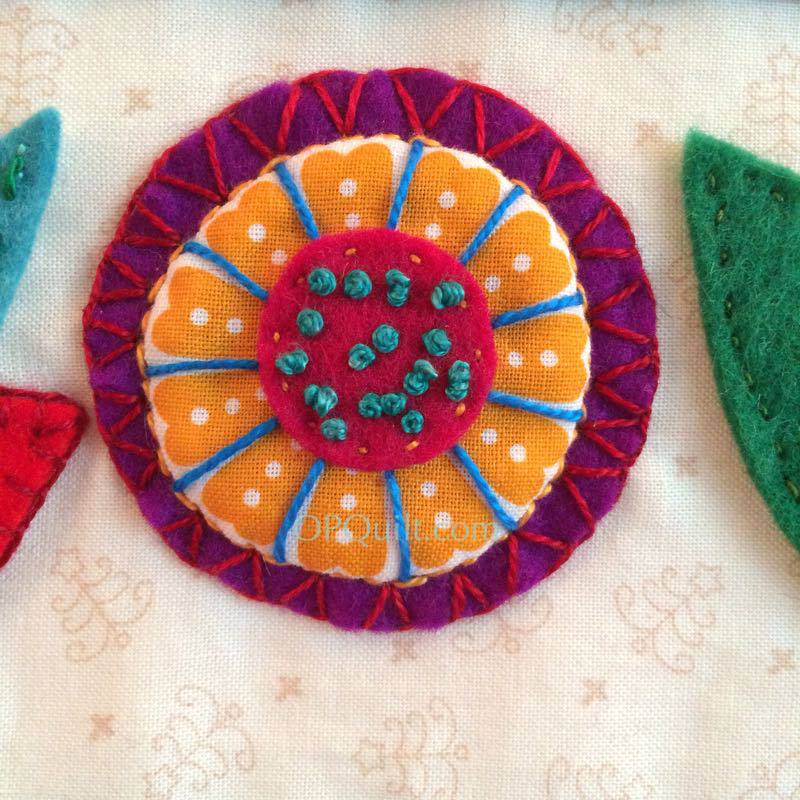
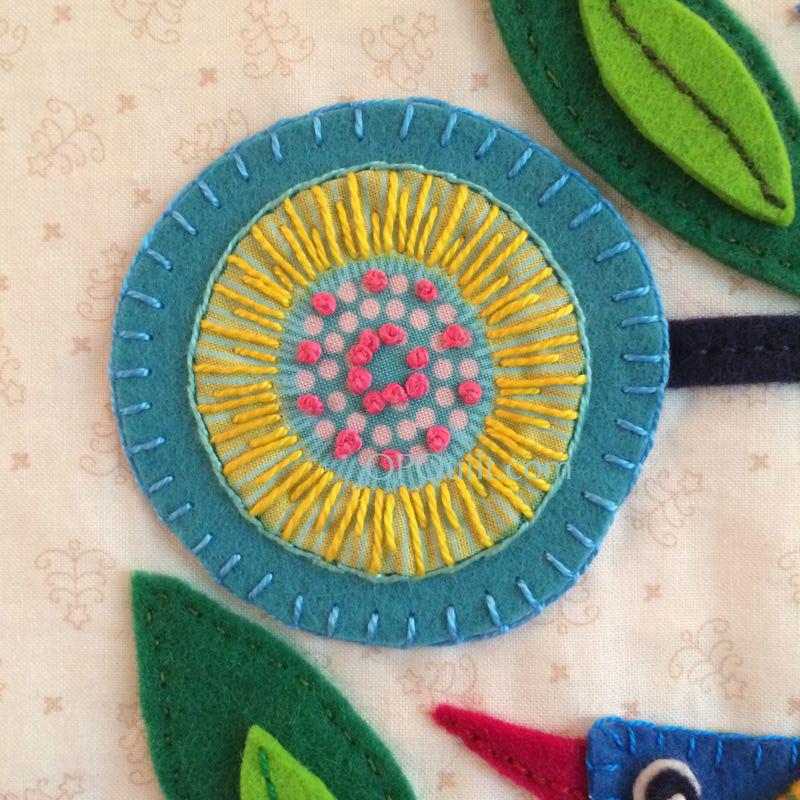
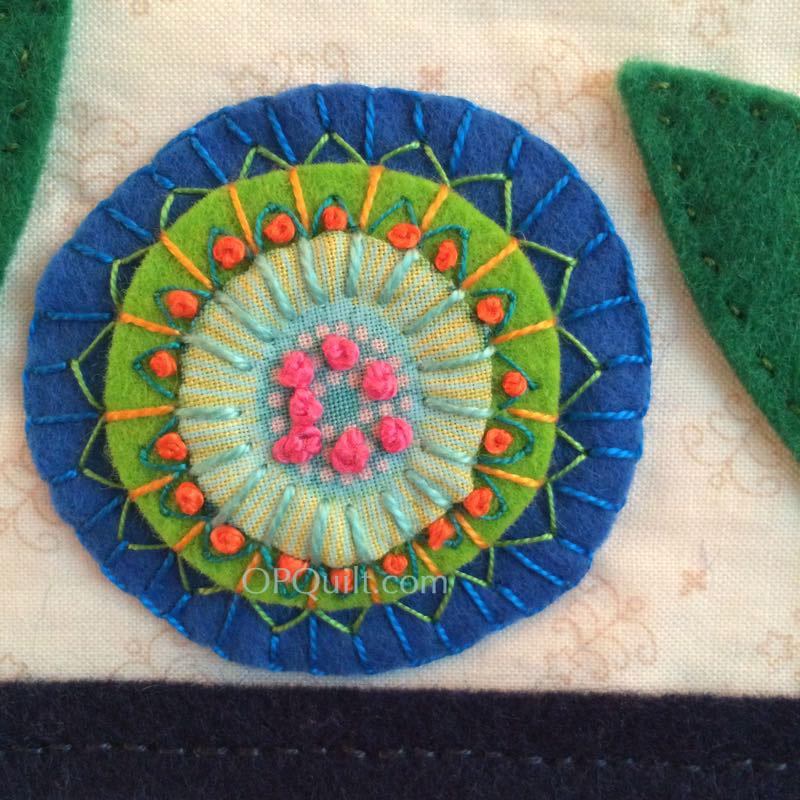
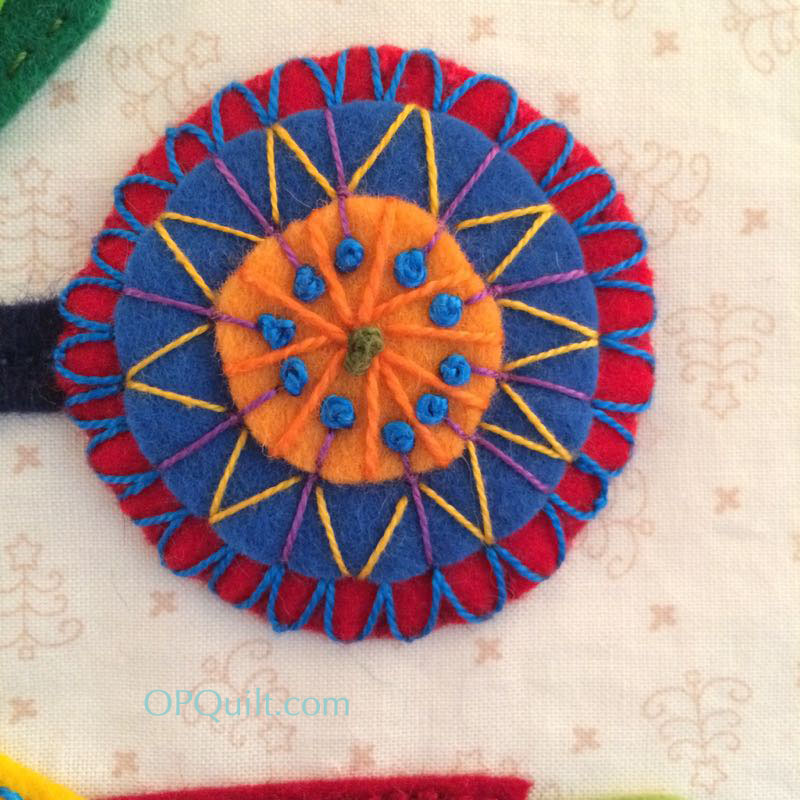
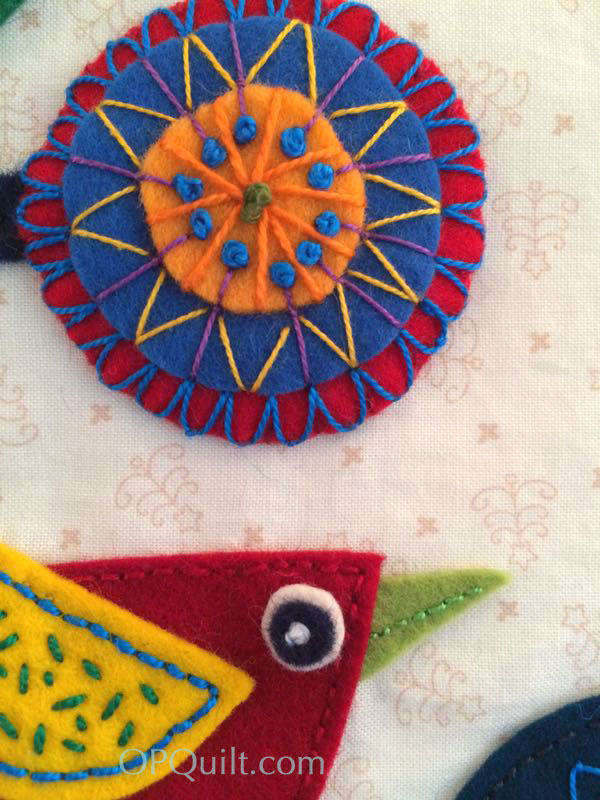
I group the way I sewed these down into two categories: A) snuggle a stitch in or around the existing embroidery, or B) adding another ring of decorative embroidery to affix it to the background.  Let’s do the A-category first.  You saw the flower medallion above; I attached it with tiny stitches at right angles to the outer edge in a matching thread.
ohchristmastree4_5a

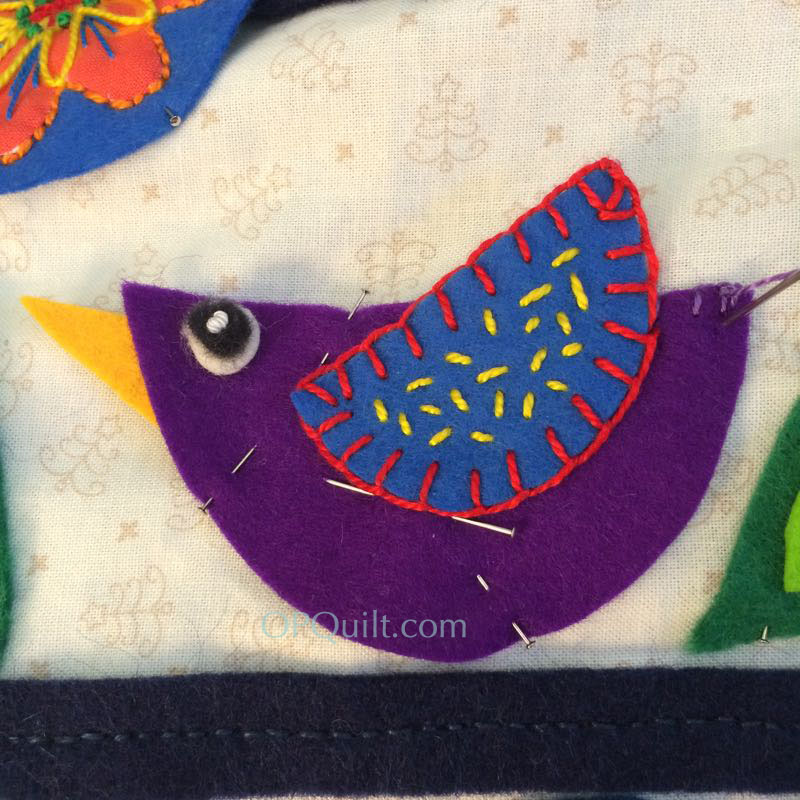
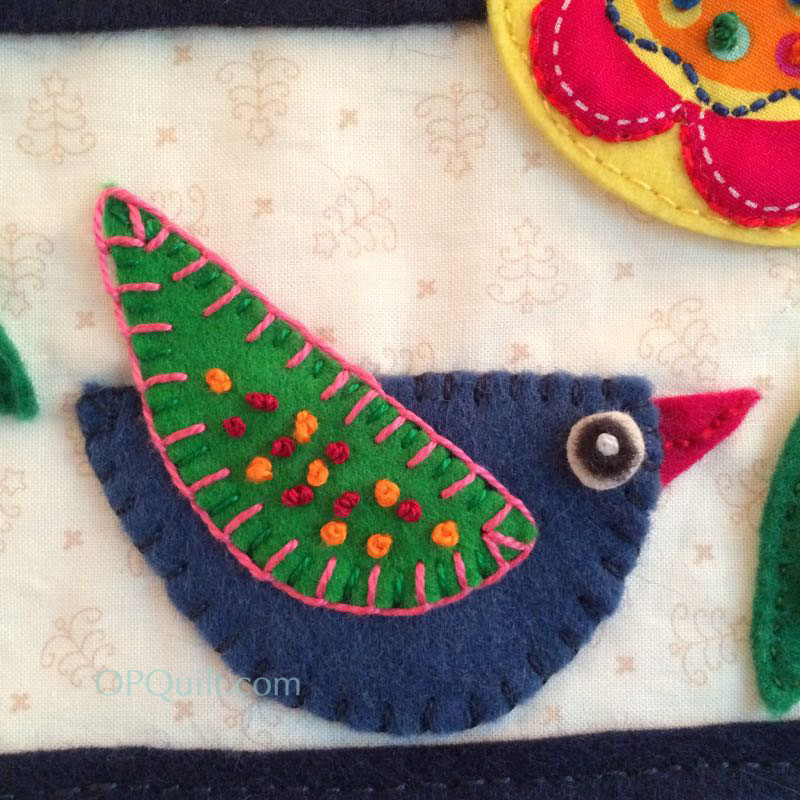
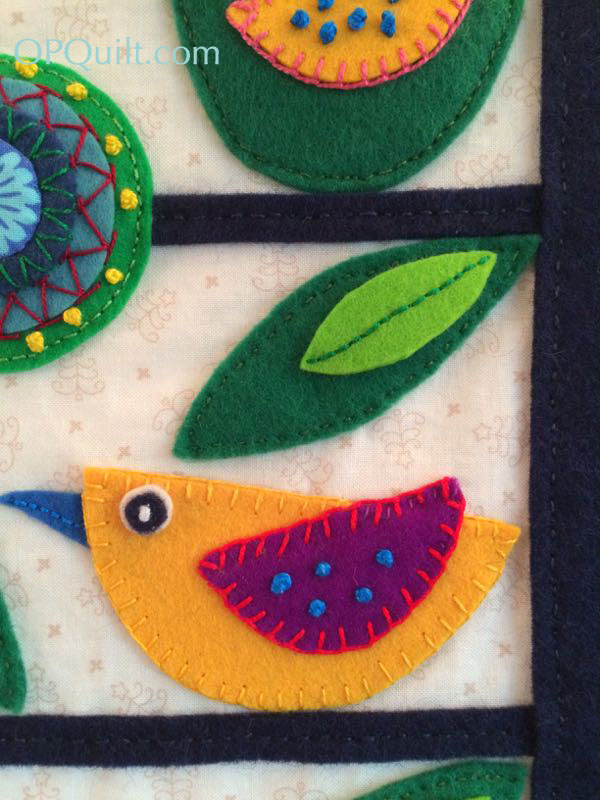
Wendy often leaves the wings undecorated, using the “attachment phase” to put the stitches on, but I’d already embroidered them when she told me this, so I sewed it down to the background by using a small matching (green) thread in between the existing decorative (pink) stitch.

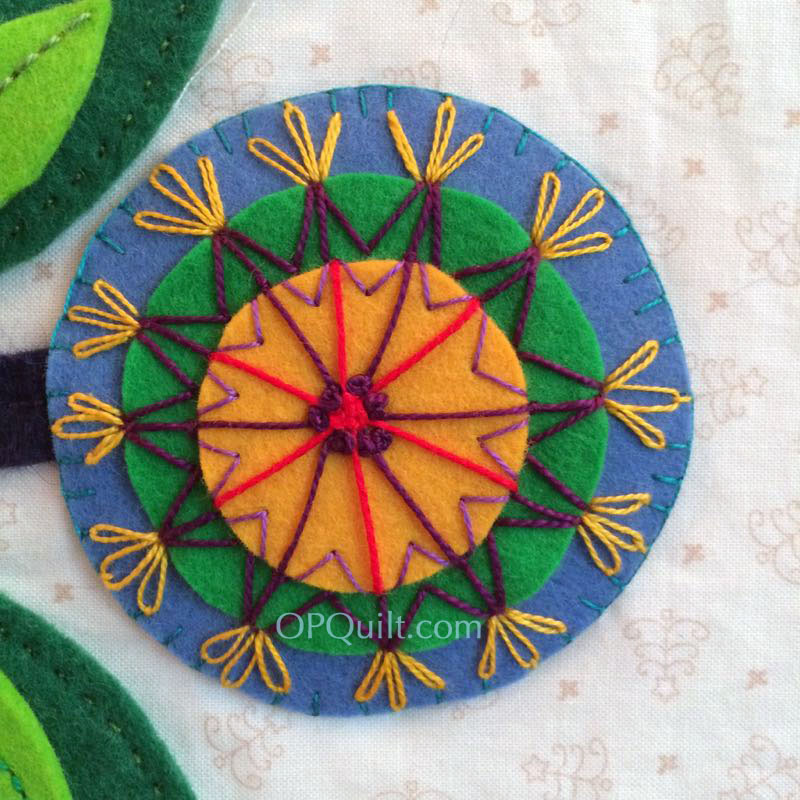
ohchristmastree4_5eI used the small perpendicular stitch again here in matching (blue) thread, but varied the length of them slightly, so the longest are between the yellow stitches and the shorter stitches are near the yellow.

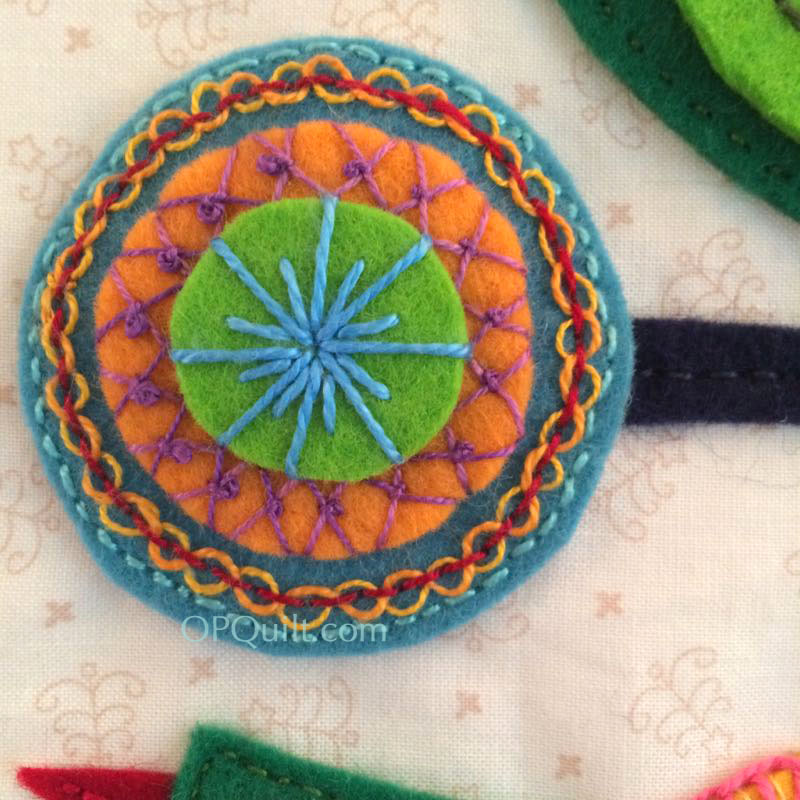
ohchristmastree4_15I also decided to keep some flowers simpler, and did a simple backstitch around the outside edge.  Keep it smallish and even, and you’ll get questions like I do: “Did you do it on the machine?”  No, and if you look closely, you’ll find the bobbly places.  Remember, this is folk art and we aim to enjoy ourselves!  More backstitching:ohchristmastree4_6 ohchristmastree4_6aohchristmastree4_6bohchristmastree4_6c

Now for some B-categories: adding another bit of embroidery to attach them.ohchristmastree4_5b

This is a slanted buttonhole stitch.  It’s done exactly the same as a regular buttonhole, but instead of keeping the needle perpendicular to the outside edge, you slant it.  I like the look of this one a lot.ohchristmastree4_5c

Regular buttonhole.  I used matching thread if I thought the flower was busy enough.ohchristmastree4_5d

Here’s where I used the backstitch (on the small yellow flower, left) and then used a different color of thread in a buttonhole stitch (magenta flower, right).ohchristmastree4_5f

Here’s an “un-even” buttonhole stitch, with shorter and longer “legs” of the stitch, co-ordinating with the existing embroidery.
ohchristmastree4_7

This bird was sewn on with a matching yellow thread, buttonhole stitch.  But I slipped a smaller seed (or regular) stitch in between the existing red buttonhole stitch on the yellow bird’s wing to sew that down.  ohchristmastree4_7a

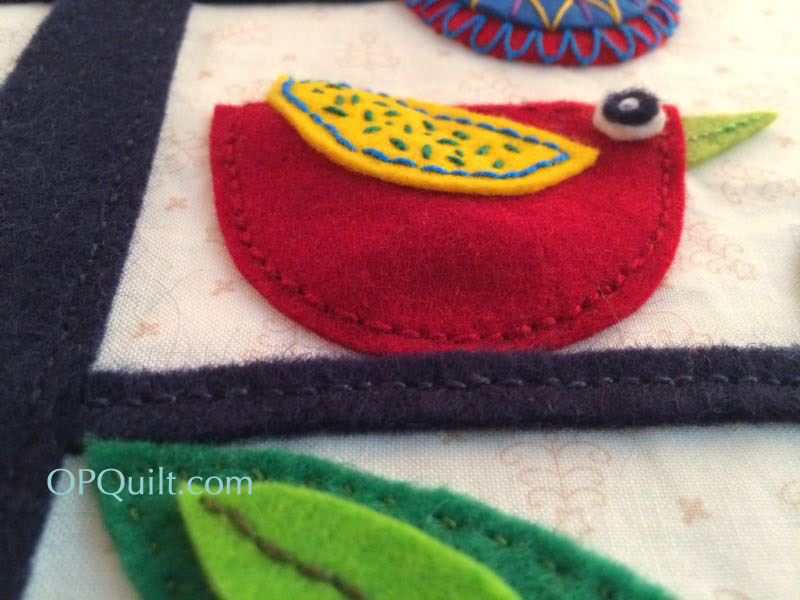
Photography of women depends on flattering angles, but I dropped the camera down low so you could see my pregnant bird.  She didn’t start out that way, but the wool shifted.  The bubbling up is exaggerated from this angle–it’s not really noticeable from the front, but now you know why I started putting that pin in the center of my birds and flowers as I stitched them down.  Didn’t have that trouble with the leaves, for some reason. She’s attached to the background with a simple backstitch.  I also did a line on the birds’ beaks.  I tried to make them happy birds (It’s Christmas, remember?) by the slight curve of the stitching, but some of the birds turned out a bit moody.ohchristmastree4_8

This is another where I snuck a small stitch in between the existing embroidery (A-category), and below, the last photo (!) where you can also see detail on the bird’s beak.ohchristmastree4_9

We are definitely getting closer to the end, now, and I’m pretty excited.  Next month (June 2nd), I’ll have an alternate scene for you for under the tree, and then we’ll roll out from there.

ChristmasTreeLogoSM

No giveaway this month, but here’s a recap of our schedule:

January, Step “prepare”: buy the magazine, books, gather your fabrics, buy the felt/wool, buy/find the pearl cotton.
February, Step 1: Make the tree on the background and stitch it down.
March, Step 2: Make 21 flowers.
April, Step 3: Make 10 birds and all the leaves.

May, Step 4: Appliqué down the flowers and birds.

June, Step 5:  Scene at bottom of tree–make, then appliqué onto background.

July, Step 6: Sawtooth border (reds); sew together and attach.

August, Step 7: (finish up Quilt-A-Long): Make wonky star blocks, sew them together and attach border #2.

September, Step 8 Show and Tell, just in time for school starting again.

Yes, we cut a month off our sewing, so you’ll have plenty of time to finish your quilt before December.

Happy Stitching and we’ll see you in June!